Microplastics in industrial wastewater
31. August 2026
REMEDIES 5.0
2. September 2026
CSRD and ESG Reporting: More Than Just Numbers on White Paper
From reporting obligations to measurable environmental impact – why clean water is the litmus test for genuine sustainability
What is this about? The CSRD is the European directive on corporate sustainability reporting. It sets out which environmental, social and governance information a company must disclose in its management report, under which standards (ESRS) and with what level of assurance. ESG, by contrast, is not a legal term but the Environment, Social, Governance framework capital markets use to sort sustainability information. This post asks whether the reporting obligation produces measurable environmental impact – using microplastics in water as the test case.
The Corporate Sustainability Reporting Directive (CSRD) has reshaped ESG reporting in Europe. But while companies struggle with complex data collection and audit requirements, one central question remains unanswered: Do these reports lead to genuine environmental protection or just elaborate bookkeeping? We conduct a critical analysis using the example of water pollution through microplastics.
The state of the CSRD in September 2026
From January 2025, the first large European companies had to report according to the Corporate Sustainability Reporting Directive. The CSRD replaced the Non-Financial Reporting Directive (NFRD) and extended reporting obligations considerably in its original form. That starting position is now out of date: the scope was sharply narrowed in 2026.
What changed in 2025 and 2026
- April 2025 – deadlines postponed: with Directive (EU) 2025/794, the so-called stop-the-clock directive, the European Parliament and the Council postponed the reporting obligation for waves two and three by two years. This was not decided by the Commission alone but by the legislator under an accelerated procedure.
- February 2026 – substantive reform: the Omnibus I Directive (EU) 2026/470 was published in the Official Journal on 26 February 2026 and entered into force on 18 March 2026. The CSRD amendments must be transposed by 19 March 2027, the due diligence amendments by 26 July 2028.
- New scope: only undertakings exceeding both thresholds remain in scope – more than 1,000 employees on annual average and more than EUR 450 million net turnover. Previously two of three criteria sufficed at 250 employees, EUR 25 million balance sheet total or EUR 50 million turnover.
- Further changes: sector-specific standards are dropped, the requirement for a Paris-aligned climate transition plan was removed, and a value chain cap applies to undertakings with fewer than 1,000 employees. The new thresholds apply to financial years beginning on or after 1 January 2027; Member States may exempt first-wave companies that fall out of scope for financial years 2025 and 2026.
|
FACT-CHECK NOTE Scale of the narrowing: according to estimates used during the legislative process, around 80 % of previously covered companies fall outside the scope of the CSRD. The frequently quoted figure of almost 50,000 reporting companies therefore describes the position before February 2026 and should no longer be used without qualification. For the due diligence directive the thresholds are now more than 5,000 employees and more than EUR 1.5 billion in worldwide net turnover. |
Political U-turns and their consequences
The narrowing of scope is no longer a proposal but applicable law. It was justified by simplification and competitiveness. Whether it undermines the goal of comprehensive sustainability transparency is a political assessment, and we mark it as such: in our view the emphasis shifts from the breadth of reporting to the depth of the few remaining reports. For environmental impact, what is measured matters more than how many report.
The water law framework: what actually applies
- EU Taxonomy Regulation (2020/852) defines technical assessment criteria for sustainable economic activities, including the sustainable use and protection of water and marine resources. It was also simplified in the Omnibus package.
- Water Framework Directive (2000/60/EC) is the main law for water protection in Europe since 2000, ensuring an integrated approach to water management
- Urban Wastewater Treatment Directive (EU) 2024/3019: in force since 1 January 2025, to be transposed by 31 July 2027. It lowers the application threshold from 2,000 to 1,000 population equivalents, requires a quaternary treatment stage for micropollutants under Article 8, and for the first time obliges monitoring of microplastics and PFAS at inlet and outlet under Article 21.
- Directive (EU) 2026/805 of 30 March 2026, in force since 10 May 2026: it amends the Water Framework Directive, the Groundwater Directive and the Environmental Quality Standards Directive, tightens standards for PFAS, pharmaceutical substances, bisphenols and pesticides, and adds microplastics to the watch lists for surface water and groundwater. Monitoring only begins once harmonised measurement methods are available. There is still no environmental quality standard for microplastics. Transposition deadline: 21 December 2027.
|
FACT-CHECK NOTE What the Urban Wastewater Treatment Directive means for companies: under Articles 9 and 10, manufacturers of human medicinal products and cosmetics bear at least 80 % of the investment, operating and monitoring costs of the quaternary treatment stage. Extended producer responsibility schemes must be set up by 31 December 2028; quantities below one tonne per year are exempt. The build-out path for plants of 150,000 population equivalents and above is 20 % by 2033, 60 % by 2039 and 100 % by 2045. Legal caveat: in Case C-193/25, Advocate General Kokott proposed on 3 September 2026 that Article 9(1)(a) and Annex III be annulled. The Court has not yet ruled. |
Microplastics: The Invisible Test Case for ESG Credibility
While companies diligently calculate CO₂ equivalents and plant trees in distant countries, they systematically neglect one of the most urgent environmental problems of our time: microplastic pollution. A modelling study puts the annual input of microplastics into the oceans at around 1.3 million tonnes. The figure is a model estimate with considerable uncertainty; other work arrives at different magnitudes depending on system boundary and size class. It should therefore be used with its source and labelled as an estimate.
The dimensions are growing. Some evidenced magnitudes:
- Globally, microplastic values fluctuate between 0.001 to 140 particles per m³ in water and 0.2 to 8,766 particles per gram in sediments – a range spanning five orders of magnitude that is largely driven by methodology
- Microplastics have been detected in widely differing ecosystems, from Antarctica to tropical coral reefs, as well as in food, beverages, and human tissues
- Microplastics are considered ubiquitous pollutants and have been detected in indoor and outdoor air, drinking water, food, and in remote locations worldwide
- According to current research, environmental pollution could roughly double by 2040 if no additional measures are taken. This is a scenario, not a forecast
Figures for the annual load of individual treatment plants vary by several orders of magnitude in the literature, because detection limit, sample volume and counting method differ. Our own long-term measurement at the Landau-Mörlheim plant, with 320 samples over two years and three months, gave a mean effluent concentration of 27.8 ± 29.8 MP/L across a range of 0.6 to 194.0 MP/L, and from that an annual load of around 1.5 × 10¹¹ particles, or roughly 2.8 million particles per inhabitant per year (Microplastics 2024, 3, 492–502). Such figures are only comparable when method and detection limit are stated.
Offsetting instead of impact: the tree planting example
Tree planting for CO₂ compensation is often marketed as an ethical solution but its effect is contested. Three criticisms recur: monocultures replace species-rich stands, many projects are not monitored after planting, and some initiatives have been associated with the displacement of local communities and with stands disappearing after a few years. In communication law the decisive point is a different one: since 27 September 2026, neutrality claims such as "climate neutral" that rest on purchased offset credits rather than on reductions within the own value chain are impermissible under Directive (EU) 2024/825.
Structural deficiencies in reforestation projects:
- Diverse forests are often cleared for agricultural production or industrial use and replaced by uniform stands of the same species
- Many reforestation projects suffer from inadequate monitoring, making it difficult to verify actual environmental benefits
- Tree planting initiatives have been associated with community displacement, introduction of non-native tree species, and tree cutting after just a few years
Greenwashing Trends in Reporting
Between September 2022 and September 2023, every fourth climate-related ESG risk incident was associated with greenwashing – an increase from 20% to 25% within just one year. An econometric study also finds a relationship between stricter environmental regulation and increased greenwashing in ESG reports. The finding describes a correlation within one dataset and does not establish a general causal mechanism.
What can be measured
As a non-profit research organisation, Wasser 3.0 takes a systematic approach to combating microplastic and pollutant contamination of water bodies .
The Wasser 3.0 PE-X® process: agglomeration–fixation
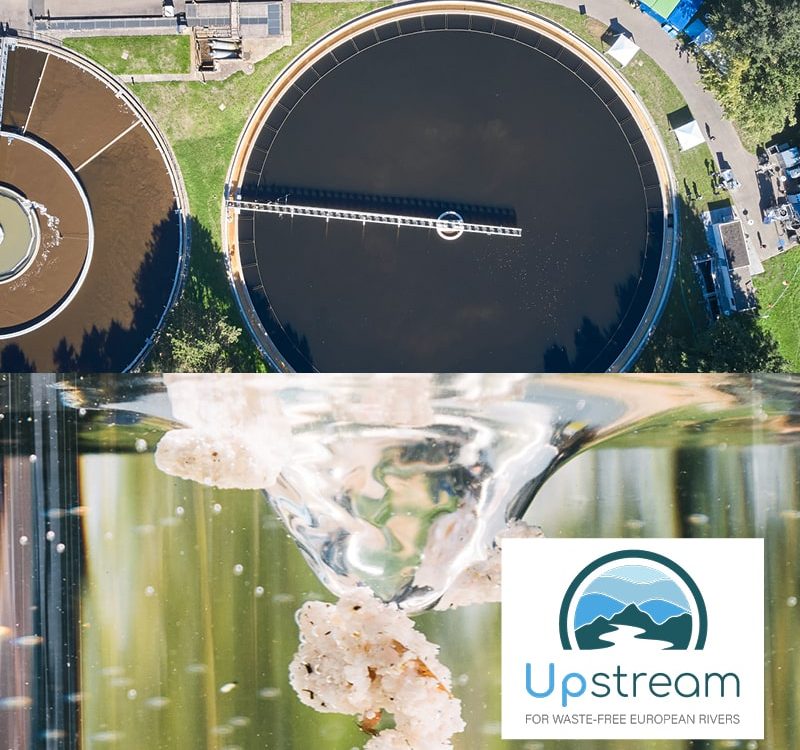
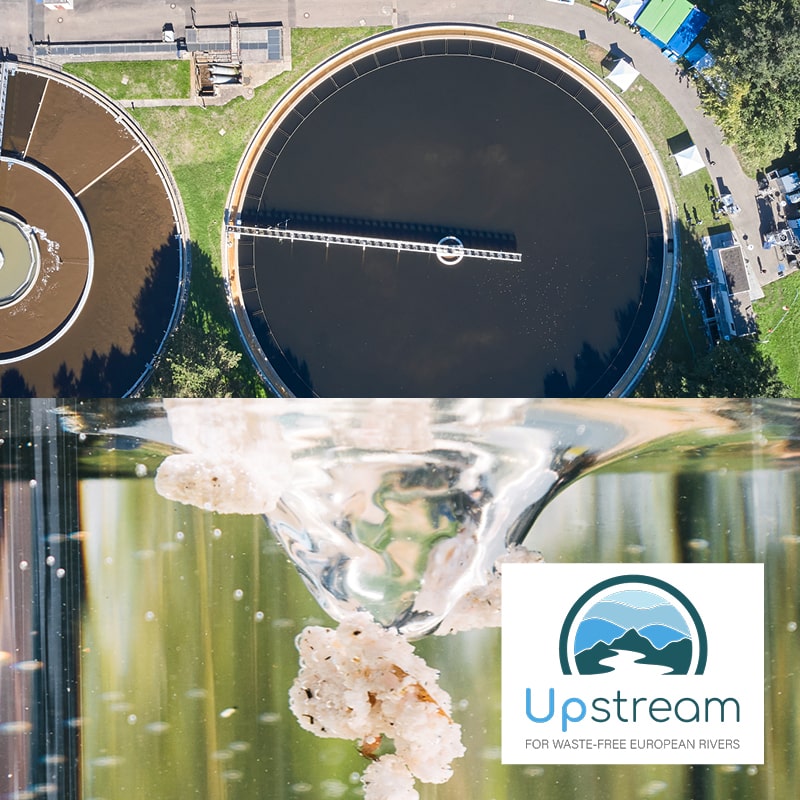
The process is based on creating a vortex in a water tank to which a compound called Wasser 3.0 PE-X® is added, which acts as a clumping agent and draws microplastics together into agglomerates that rise to the surface.
Evidenced performance data:
- Removal rates achieved across four published pilot applications range from 86 ± 8 % to 99.1 %, in each case by particle count above the 10 µm detection limit. The achievable value depends on water matrix and initial load; a matrix-independent single figure is not promised
- The technology works independently of water temperature (7.5 to 40 °C) and water type (wastewater, seawater, demineralized water); this range was tested in laboratory trials (Water 2021, 13, 675)
- Treatment reduces microplastics by 98.26 % (TSS) and 97.92 % (particle count), preventing 1.1 kg MP/m³ water and an estimated 2.7 t MP/year at one plastics processing site (Water 2024, 16, 268). The annual figure is a projection from pilot data
Circular Economy Instead of Disposal
The recovered agglomerates are being investigated as a filler in construction materials; the life cycle assessment modelled replacing silica sand in concrete mixtures as a scenario rather than documenting it as current practice. Additionally, process chemicals and process waters are recovered at the desired pH and temperature.
Measurable Sustainability Metrics: From Double Materiality to Measurable Quantities
A central concept introduced by the CSRD is double materiality, meaning companies must disclose both the financial impacts of sustainability risks and their environmental and social impacts. The Omnibus I Directive retained this principle but streamlined the set of ESRS and removed the sector-specific standards.
- Impact materiality: direct impacts on water quality through production processes
- Financial materiality: risks from water scarcity, regulation, and reputational damage; from 2028, dischargers placing medicinal products or cosmetics on the market also face the cost contributions under Articles 9 and 10 of the Urban Wastewater Treatment Directive
Concrete Measurement Methods for Water Impact
Our solutions are based on standardized detection, enabling the identification of microplastic pollution hotspots and the targeted and precise reuse of the agglomerates. This results in quantifiable indicators, which include:
- Microplastic elimination rate (particles/m³ before and after treatment) – robust only above a sufficient number of samples: securing a mean within a ±25 % margin of error requires 21 large-volume samples or 51 grab samples (Microplastics 2026, 5, 75)
- Prevented environmental burden (kg microplastics per year)
- Water recovery rate (share of recycled process water) – up to 80 % in pilot operation at a packaging production line (Clean Technol. 2025, 7, 67)
- Material recovery (tonnes of recoverable agglomerates)
- Global warming potential of the treatment, reported per cubic metre of treated wastewater: 25.4 kg CO₂ equivalents in pilot operation and 1.0 kg CO₂ equivalents in the optimised circular concept (Water 2025, 17, 671). We do not speak of a net saving, because the treatment itself causes emissions and the comparison is drawn between two of our own plant concepts
Measurement methods: the actual bottleneck
The JRC has published the world’s first reference material that helps laboratories improve the analysis of microplastic particles in water. Unfortunately, the standardization protocols don’t work as desired. Other reference material providers also see a lucrative business with counted particles, but no one can yet master the factor of foreign contamination and heterogeneous distribution.
For microplastics the methodological position is split: for drinking water, Delegated Decision (EU) 2024/1441 has provided a harmonised measurement methodology since 2024 under the Drinking Water Directive (EU) 2020/2184. For wastewater, sewage sludge and surface waters it is missing. The Commission must establish the corresponding methods under the Urban Wastewater Treatment Directive, several of them by 2 January 2028. As long as they are absent, adding microplastics to the watch lists under Directive (EU) 2026/805 has little practical effect.
The proposal to update the pollutant lists has since been concluded: the Council formally adopted the directive on 17 February 2026, it was signed on 30 March 2026 and entered into force on 10 May 2026. For microplastics, however, it remains monitoring rather than a quality standard.
|
FACT-CHECK NOTE Position in Germany, September 2026: the federal framework of the Water Resources Act, the Wastewater Ordinance, the Wastewater Charges Act and the surface water and groundwater ordinances exists, but alignment with the Urban Wastewater Treatment Directive and with Directive (EU) 2026/805 is still outstanding. As of early September 2026 no transposition procedure had been completed. Deadlines: 31 July 2027 for the Urban Wastewater Treatment Directive, 21 December 2027 for Directive (EU) 2026/805, and 19 March 2027 for the CSRD amendments under the Omnibus I Directive. |
From reporting obligation to measurable quantity
The next generation of ESG reporting must transition from pure compliance fulfillment to verifiable measurable quantities. Water as an essential foundation of life offers a measurement area in which impact can be expressed directly as particle counts, loads and reuse rates.
Four starting points for companies
- Integrated production improvement: companies can markedly reduce microplastic discharge at their production sites while simultaneously recycling process water
- Transparent success measurement: particle counting with a stated detection limit and sample number, alongside CO₂ equivalents
- Circular economic value creation: transformation of pollutants into recoverable materials
- Scalable technology: modular, low-maintenance, and cost-effective processes for various application areas
Recommendations for action
For companies:
- Water footprint analysis: microplastic monitoring at the relevant discharge points, with a defined sample number and a documented detection limit
- Technology partnerships: cooperation with research and technology partners
- Circular integration: transformation of waste streams into value-creation cycles
- Transparency-plus: publication of detailed, verifiable environmental impact balances stating reference basis, method and dispersion
For regulators:
- Standardization of measurement technology: harmonized methodology for measuring microplastics in wastewater, sewage sludge and surface waters – for drinking water it already exists
Conclusion: Water as the "Truth Serum" of Sustainability
The CSRD marks an important step, but its real test lies not in the completeness of reporting, but in the measurability of genuine environmental impact. After the Omnibus reform markedly fewer companies report; all the more depends on the remaining reports containing verifiable figures. Technologies whose effect can be expressed in particle counts and loads are available and documented in peer-reviewed work.
Low-microplastic water is a favourable measurement area, because input and retention can be quantified at a defined discharge point. We do not speak of water that is "free" of microplastics: below the 10 µm detection limit, absence cannot be demonstrated.
In short: more than numbers on white paper is required – namely numbers with a reference basis, a method and a dispersion measure.
|
TRANSPARENCY NOTE ON SOURCES AND DATA STATUS Legal position as at 14 September 2026. Legal sources are the original texts in EUR-Lex and are linked in the body. The decisive acts are the Omnibus I Directive (EU) 2026/470, the stop-the-clock Directive (EU) 2025/794, the Urban Wastewater Treatment Directive (EU) 2024/3019 and Directive (EU) 2026/805. Own performance data come from peer-reviewed publications; all percentages for microplastic removal refer to particle count above the 10 µm detection limit unless mass is expressly stated. |