dm-drogerie markt becomes Kilometre Partner of DANUBE 2850
11. August 2026
New Jobs in Landau
26. August 2026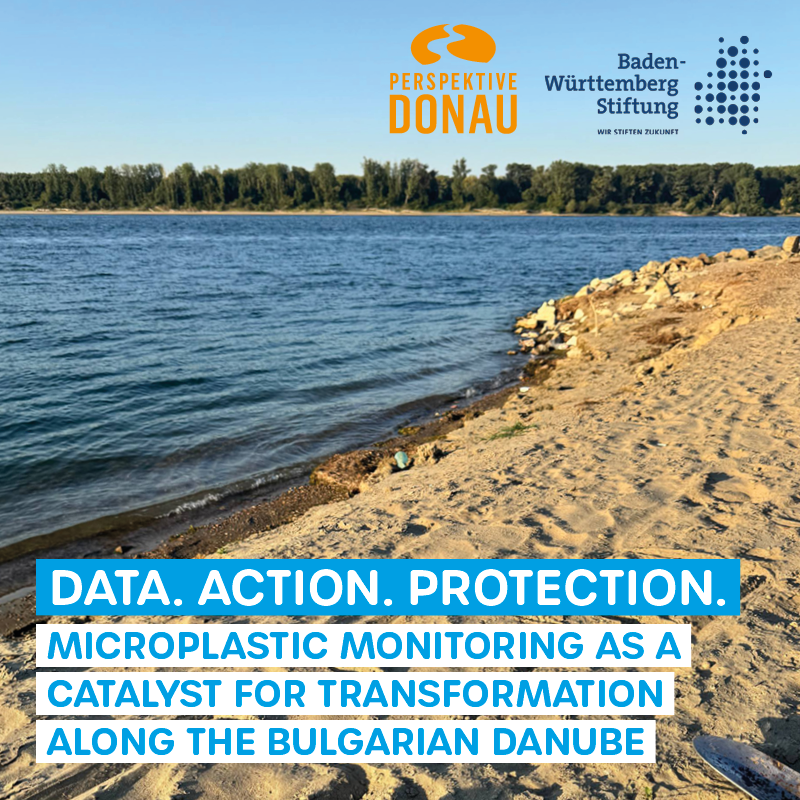
450 kilometres, one river, one data gap: Data4Danube Bulgaria starts
Between Vidin and Silistra the Danube flows through Bulgaria – and nobody knows exactly how much microplastic it carries along the way. Together with LessPlastic Bulgaria we are closing this gap. Funded by the Baden-Württemberg Stiftung under the “Perspektive Donau” programme.
There are numbers you read once and never forget. This is one of them: an estimated 4.2 tonnes of microplastics flow down the Danube into the Black Sea every day. 83 million people in ten countries live along this river and from it.
And then there are the numbers that do not exist. For the Bulgarian stretch of the Danube – around 450 kilometres between Vidin and Silistra – there is still no uniform, comparable data basis on microplastic pollution. No monitoring network, no mapping, no foundation to build on. Local decision-makers cannot act because they do not know where the pollution is greatest.
That is precisely what Data4Danube Bulgaria changes. From July 2026 to July 2027, together with our Bulgarian partner organisation LessPlastic Bulgaria, we are creating the first standardised microplastic mapping of this river section. This is made possible by funding from the Baden-Württemberg Stiftung under the Perspektive Donau programme.
What we have planned
The approach is deliberately multi-layered – data alone changes nothing if nobody understands it, and education alone changes nothing if it lacks substance. That is why four levels interlock:
Science. With Wasser 3.0 detect, our validated fluorescence marker analytics, at least 50 scientifically valid data points will be generated. The decisive point: the analytics kits can be shipped. What normally requires specialist laboratories, weeks of work and considerable cost thus becomes feasible for the first time as citizen science monitoring across 450 river kilometres. All data will be published permanently and publicly in the Global Map of Microplastics.
Civil society. Three Bulgarian school classes with around 75 pupils will take samples themselves and enter their results into the database themselves. At least 20 volunteers will take part in the coordinated sampling along the section. Those who measure, understand. Those who understand, act. The basis for this is our educational programme for schools – for this project fully available in Bulgarian for the first time.
Capacity transfer. LessPlastic Bulgaria will be trained in standardised microplastic analytics and will be able to continue working independently once the project ends. This is not top-down knowledge transfer: we contribute the methodology, LessPlastic Bulgaria contributes the language, the network and the knowledge of the local context.
Policy. The project concludes with a policy brief in Bulgarian and English that translates the measurement data into concrete recommendations for action – for municipalities, the Bulgarian Ministry of the Environment and EU institutions. A stakeholder dialogue brings data and decision-makers to the same table.
Who is on board: LessPlastic Bulgaria
Whether this project works depends on our partner on the ground. LessPlastic Bulgaria is a non-profit non-governmental organisation based in Sozopol – and it has a founding story that runs surprisingly close to Germany.
It all began at the end of 2016 as a student idea at RWTH Aachen University, inspired by a lecture on the Anthropocene – the epoch in which humans have become the defining factor for the Earth system. One of the steepest rises in the statistics of this epoch: plastic production.
That idea has grown into an organisation that today systematically records plastic waste along the Bulgarian Black Sea coast, coordinates beach clean-ups, runs workshops for schools and companies and produces independent studies. Volunteers have collected more than 6,800 kilograms of waste so far. The “Clean Christmas” campaign has become a hallmark of the organisation. Its work follows four priorities, at the heart of which stands education as the most important tool for change – a conviction we share.
LessPlastic Bulgaria is not merely a partner for action, but is scientifically active. Team members have contributed to studies on:
- the concentration, seasonal variation and composition of marine litter on the Black Sea coast – a case study of Ropotamo in the nature reserve of the same name
- high microplastic pollution in marine sediments around urbanised areas along the south-western Bulgarian Black Sea coast
- the effects of extreme weather events on floating marine litter in the Bay of Burgas
Within the project, LessPlastic Bulgaria takes on coordination on site: approaching the schools along the Danube section, mobilising the volunteers, running the educational workshops in Bulgarian, local press and stakeholder work, and helping to shape the policy brief. The contacts are Stiliana Stoyanova and Nikola Bobchev. Anyone who would like to follow the organisation’s work can do so here: Instagram, Facebook and LinkedIn.
What connects us is a shared observation: the organisation works where everything the river carries ends up. For the first time, measurements are now being taken upstream instead of merely collecting the consequences.
Data4Danube Bulgaria is funded by the Baden-Württemberg Stiftung as part of the Perspektive Donau programme.