ESG and CSRD Reporting
1. September 2026
REMEDIES 5.0: Data First, Technology Second
Four years. 13 sites. 52 partners. And one principle we apply consistently on Sylt and along the Danube.
There is a reflex we keep running into in the water sector: first a technology gets bought, then people check whether it was needed at all. That is expensive, it frustrates everyone involved, and in the end it delivers no reliable answers.
We do it the other way round. On 1 September 2026, REMEDIES 5.0 begins, one of the largest European undertakings for restoring waterfront cities and ports. 52 partners from 15 countries, 13 demo sites across all four European sea and river basins. We are involved in three places with real responsibility, and everywhere we start with the same question: what is actually in the water?
The key points in 30 seconds
- On Sylt, seawater yields several products: sea salt, brine and potential drinking water that is produced and qualified in the process. We measure how contaminated the raw material and the products are with microplastics.
- On that basis we assess whether and where a removal stage makes sense. The data decide, not gut feeling.
- On the Danube we map more than 50 sampling points together with schools and volunteers.
- Across Europe we lead the work package on adapting water treatment technologies.
-
Duration: 1 September 2026 to 31 August 2030. All results will be public.
Why Sylt of all places?
Because something happens there that happens far too rarely: seawater is taken seriously as a raw material.
Around 18,000 people live on the island. Every year more than 600,000 guests come on top. The project builds a sustainable desalination plant there, constructed by the plant engineering company Taprogge, which leaves no liquid waste stream behind. It is operated on site by Sylter GenussMacherei around Alexandro Pape and his team. The North Sea water yields several usable products at once: sea salt, a concentrated brine and potential drinking water, which the new process produces and which is then analysed and qualified. One raw material becomes several value streams. At the GenussMacherei, technology and knowledge transfer come together. What emerges is a kind of transparent production. Together we are building a real-world laboratory that informs people, explains the issue and shows how the blue economy can work.
Our part: we want to know what is in there, and to share it
What ends up in these products depends on what was in the seawater beforehand. And that is precisely what nobody knows exactly. So, we deliver the numbers first. In concrete terms: we measure the microplastic load at every relevant point along the chain, in the raw water from the North Sea, in the highly concentrated brine, in the sea salt produced and in the potential drinking water the new process delivers. To do that we adapt our microplastic analytics to the individual water matrices. Each behaves differently; each needs its own sampling and preparation protocol. Then there is the seasonal factor: in August an island with 600,000 guests looks rather different from February.
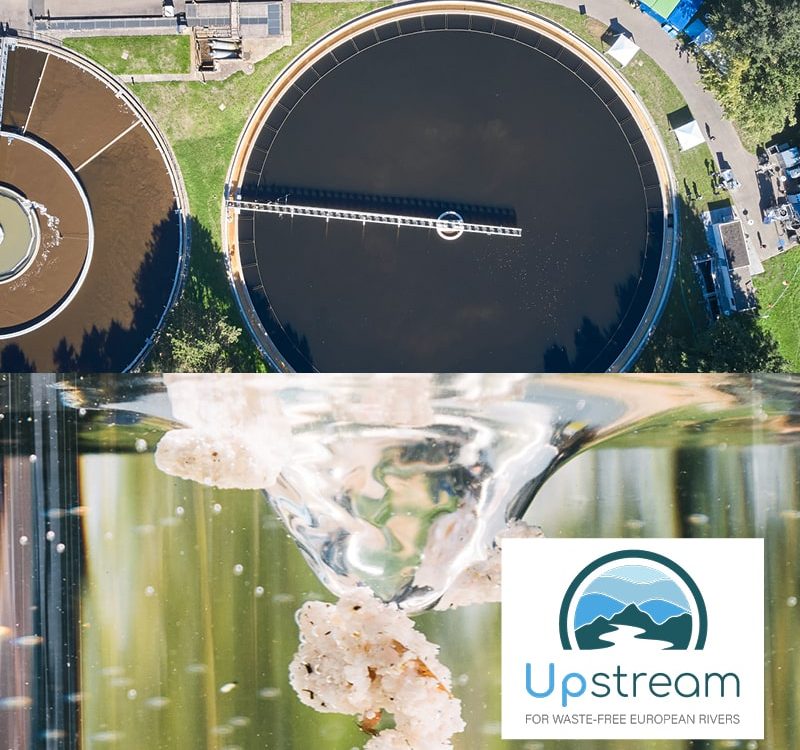
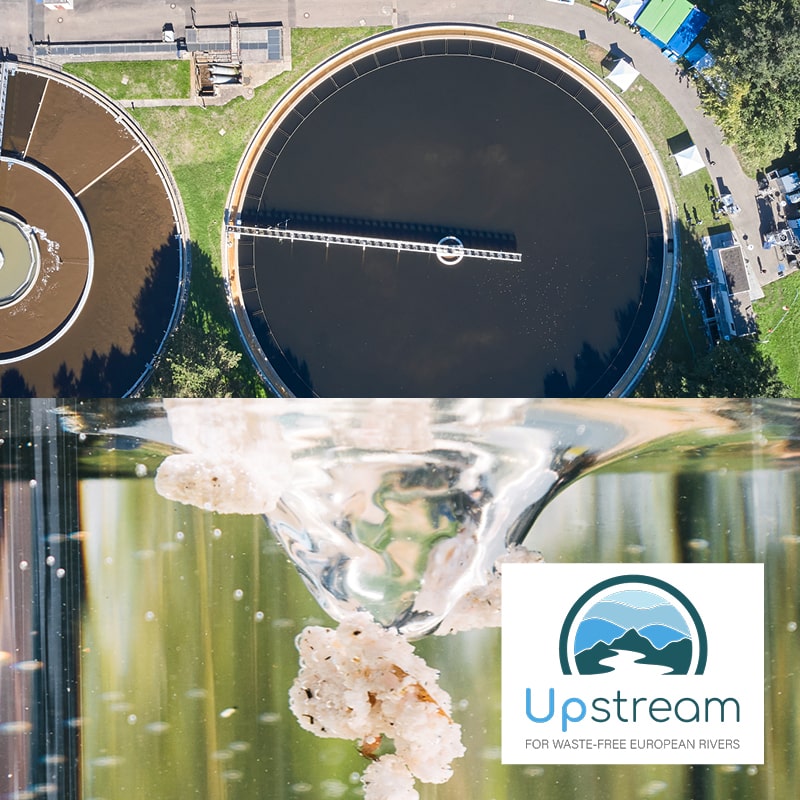
And then? Then it gets assessed. From the data we work out together with the project partners whether an additional removal stage is needed at all, where in the process it would deliver the most and whether the effort pays off ecologically and economically. If the assessment points that way, Clump & Skim is a proven process ready to go: hybrid silica gels clump the particles into popcorn-like agglomerates that float to the surface and are skimmed off without any filter.
Just as important is the other possible outcome: if the measurements show no relevant contamination, nothing gets built. That, too, is a result, and one that every other desalination plant in Europe needs before it invests.
What counts in the end is not the individual plant but the transferable approach: first know what is in the raw material, then decide which products come out of it and what treatment they need. Implementation on site is led by the municipality of List auf Sylt, the regional processing of the sea salt is handled by Sylter GenussMacherei. That is reuse in the literal sense.
The Danube: more than 50 measuring points, thousands of hands
The second part of our work lies far from the North Sea, yet follows the same principle. Together with the University of Natural Resources and Life Sciences, Vienna (BOKU) we lead the microplastic campaign on the Danube. More than 50 standardised sampling points. Sampled by pupils and volunteers. Analysed and validated twice in our microplastic laboratory. This connects directly to DONAU 2850, our ongoing project for the first continuous mapping of Europe's second longest river.
Why this is more than collecting data: A piece of plastic that enters the Danube near Ulm is in the Black Sea weeks later. There it breaks down into particles that nobody can collect any more. Whoever measures upstream can act downstream. That is the core of the land-to-river-to-sea approach REMEDIES 5.0 pursues. We have already published first results from our mapping here on the blog.
All measured values flow openly into the Global Map of Microplastics as well as into the European data platforms EMODnet and the Digital Twin of the Ocean. No figure disappears into a drawer.
Three roles in which we lead
In European projects the question is not only whether you take part, but where you carry responsibility. In REMEDIES 5.0 we carry it in three places:
- Work package lead, water treatment. We coordinate across Europe how monitoring and treatment technologies are adapted to the 13 sites, from wastewater treatment plants and seawater to rivers.
- Demo site lead, Sylt. Full technical responsibility: baseline measurement, assessment, implementation, verification.
- Joint project lead of the Danube campaign with BOKU. Methodology, training, analytics, validation and evaluation.
Behind this stands the same systematic approach we always follow, and in exactly this order: detect, first know what is in there. remove, then take it out, if the data warrant it. reuse, and make something out of it. What is new is the scale. All ongoing projects can be found on our project page, the scientific basis in our publications.
And you? Three ways to join in
- Measure it yourself. Whether school class, association or individual: our offers for schools and citizen science show how sampling works. Your measured values end up in the Global Map of Microplastics and become part of a European dataset.
- Understand it and pass it on. In our knowledge base we explain without jargon what microplastics actually are, where they come from and why wastewater treatment plants have not retained them so far.
- Support us. We are a non-profit. Funded projects cover research, not everything else. Anyone who wants to make educational work and open data possible can support us with a donation or a partnership.
The roadmap to 2030
| From autumn 2026 | Project start, local kick-off on Sylt, setting up the stakeholder platform |
| 2026 to 2027 | Baseline measurement: microplastic and water analytics as an inventory |
| 2027 bis 2028 | Assessment of the data and an action plan developed together with the municipality |
| Ab 2028 | Implementation of the derived measures and support for the plant technology |
| Ab 2027 laufend | Danube campaign with more than 50 sampling points and citizen science |
| Bis Sommer 2030 | Public results reports, blueprints and replication in further cities |
Frequently asked questions
Stay tuned: We report regularly from the project. You will find all articles on our blog.
Funded by the European Union. Views and opinions expressed are however those of the author(s) only and do not necessarily reflect those of the European Union or the European Climate, Infrastructure and Environment Executive Agency (CINEA). Neither the European Union nor the granting authority can be held responsible for them.