Microplastic Mapping in Germany and Europe
22. July 2026
Microplastics in the Danube: first mapping in Bulgaria
18. August 2026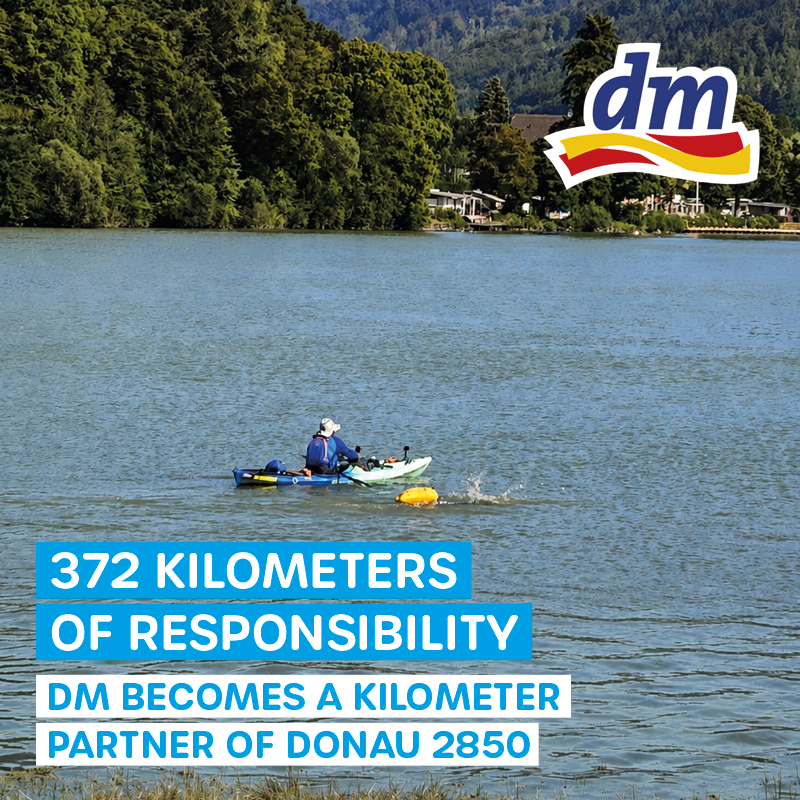
372 Kilometres of Responsibility: dm-drogerie markt Becomes Kilometre Partner of DANUBE 2850
From Passau to Bratislava, dm-drogerie markt is taking on the sponsorship of one of the best-known sections of the river – through the Wachau, Vienna and Donau-Auen National Park. A company that has spent years trying to keep microplastics out of its products is now making sure they become visible in the river.
There are stretches of river that everyone knows. The Wachau with its terraced vineyards. Vienna, where the Danube flows right through a city of millions. Donau-Auen National Park, one of the last great floodplain landscapes in Central Europe. And precisely these 372 kilometres between Passau and Bratislava have so far been – like the rest of the river – a blank spot on the map when it comes to microplastics.
That is changing. We are delighted to welcome dm-drogerie markt as a Kilometre Partner of the DANUBE 2850 project.
The Mission: 2,850 Kilometres for Europe’s Water
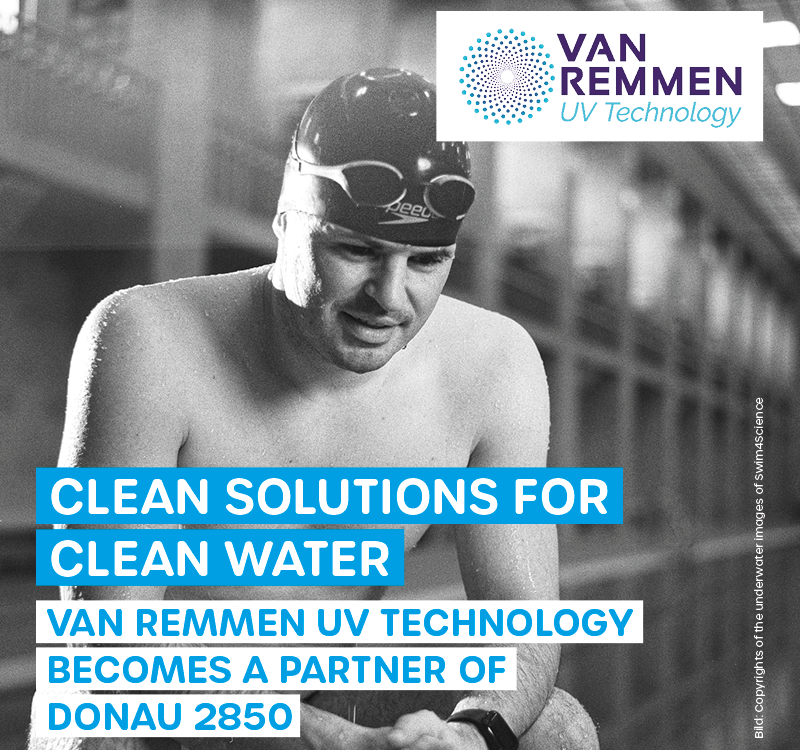
Since the beginning of July, extreme swimmer Dr Joseph Heß has been under way: 2,850 kilometres through ten countries, around 60 days, eight to ten hours in the water every day, sometimes more. What sounds like an exceptional sporting feat is also a scientific expedition. More than 250 water samples are taken directly from the Danube and on land, analysed for microplastics in our laboratory and published on the Global Map of Microplastics.
The Section: Passau – Bratislava
The 372 kilometres that dm is taking on are no arbitrary stretch. Here the Danube leaves Germany, crosses Austria along its entire length and reaches Slovakia at Bratislava. Along this route the river meets a UNESCO World Heritage landscape, a European capital with its discharges and entry pathways, and a protected area that is a valuable reference space precisely because of its near-natural state.
The Wachau, Vienna, the Donau-Auen – everyone knows these landscapes, and nobody knows how much microplastic is floating in them. That is exactly the problem we are solving. In dm we have a partner that is not waiting for regulation but making data possible.
For microplastic mapping, this diversity is worth its weight in gold: where wine-growing landscape, urban conurbation and floodplain wilderness alternate within just a few hundred kilometres, sources of input can be told apart particularly well. Every kilometre of this section is scientifically evaluated and permanently linked to the name dm on the Global Map of Microplastics.
dm: Avoiding Microplastics – and Making Them Visible
That it is of all things a drugstore chain carrying this section is anything but a coincidence. Cosmetics and cleaning products are among the product groups through which microplastics, and liquid synthetic polymers can enter the water cycle.
dm has been working on this for more than a decade: back in 2014, the company removed plastic microparticles from all rinse-off and wash-off dm brand products for body and dental care. Since then, formulations containing synthetic polymers have been continuously revised – going beyond the statutory EU requirements.
Microplastics are an important field of action for dm, with a clear goal: to minimise the microplastic discharge caused by, or capable of being influenced by, the company. In doing so, dm goes beyond the mere ingredients of its formulations. This shows in detail that often go unnoticed on the shelf: sun spray caps, once regarded as a littering risk, have been redesigned so that no components can be detached any more – with less environmental input and less material use. For textiles, cut edges are treated with lasers, because studies show that fibre abrasion is highest during the first wash. And in its value chains, dm is working with partners to address tyre abrasion in logistics, a significant source of microplastic inputs into the environment.
Avoiding is one side of it. Knowing where the material ends up is the other. This is exactly where our approaches interlock: while dm starts at the source, we provide, with microplastic analytics and microplastic removal, the methods to make the invisible burden visible first and then treatable.
What a Kilometre Partnership Means
A kilometre partnership is not sponsorship in the classic sense. Whoever takes on a section finances sampling and analytics along exactly that stretch – and thereby makes possible data that did not exist before. The results are publicly accessible, permanently documented and traceably linked to the respective partner.
A stretch of river thus becomes a piece of responsibility. Verifiable, not merely claimed.
Fresh water is the basis of life for everyone and therefore for our health and for the vitality of the ecosystems we all depend on. Local waters need our special protection, and that is why we want to learn. We are therefore glad to work together with the team at Wasser 3.0 to strengthen awareness of water quality and to create facts that help us develop solutions for cleaner water and for the recovery of this habitat. Because what floats in the Danube does not stay in the Danube – it also goes into the sea! The initiative makes visible how closely clean water, living nature and our shared future are connected. We want to create facts and gather experience about where the biggest drivers of microplastics come from.
A Signal Across Borders
That a company with around 4,100 stores in 14 countries is carrying a section touching three states fits the European spirit of the project: water knows no national borders, and neither may water protection. From Passau via Vienna to Bratislava, the Danube is a shared river – and a shared problem, as long as nobody knows exactly what is floating in it.
Avoiding microplastics and measuring microplastics are two sides of the same task. dm has been working at the source for years – we work at the river. That a retail company is taking on a section from which millions of people draw their drinking water every day shows: responsibility does not end at the shelf.
We invite further companies to become Kilometre Partners of the Danube expedition. Around 900 kilometres are still open. Because every kilometre counts. For science. For policy. For water.