
Microplastic removal saves water, energy, and costs
23. July 2026
Microplastic Removal and Climate Impact
9. August 2026
Ocean Bound Plastics: Between Marketing Myth and Ecological Reality
The following is a critical assessment of Ocean Bound Plastics, recycled products, and virgin plastics, based on published studies, official sources and market data – beyond marketing rhetoric. Evaluative statements are marked as such and kept separate from substantiated factual claims.
The core argument upfront: Ocean Bound Plastics are, in our assessment, predominantly used as a marketing instrument and are not an ecological game-changer
Companies using Ocean Bound Plastics (OBP) in their products market this as a solution to the plastic crisis, but the available evidence supports that promise only to a limited extent. This article describes common marketing patterns, puts the available life cycle data into context, and shows what a transformation of the plastic economy can look like.
What are Ocean Bound Plastics?
Ocean Bound Plastics go back to work by Dr. Jenna Jambeck and colleagues published in the journal "Science" in 2015. The term refers to improperly disposed plastic waste generated by populations living within roughly 50 km of coasts and waterways that could enter the ocean as marine debris if no intervention takes place.
Important for communication: "Ocean Bound Plastic" is not a legally defined term. Only private certification standards exist. From 27 September 2026, a self-awarded sustainability label without an independent, third-party monitored certification scheme is prohibited outright under the EmpCo rules and their national transpositions, such as the blacklist of the German UWG. The term alone does not substantiate any environmental property.
Most plastics advertised as "Ocean Bound" do not come from the sea, but from coastal regions – before they even reach the ocean. This is where the marketing loophole opens up: contrary to what many people assume, Ocean Bound Plastics are not plastic waste from the world’s oceans. Yet this is exactly what many advertising photos and video clips suggest. Individual documented cases involving large brands are described below with source references.
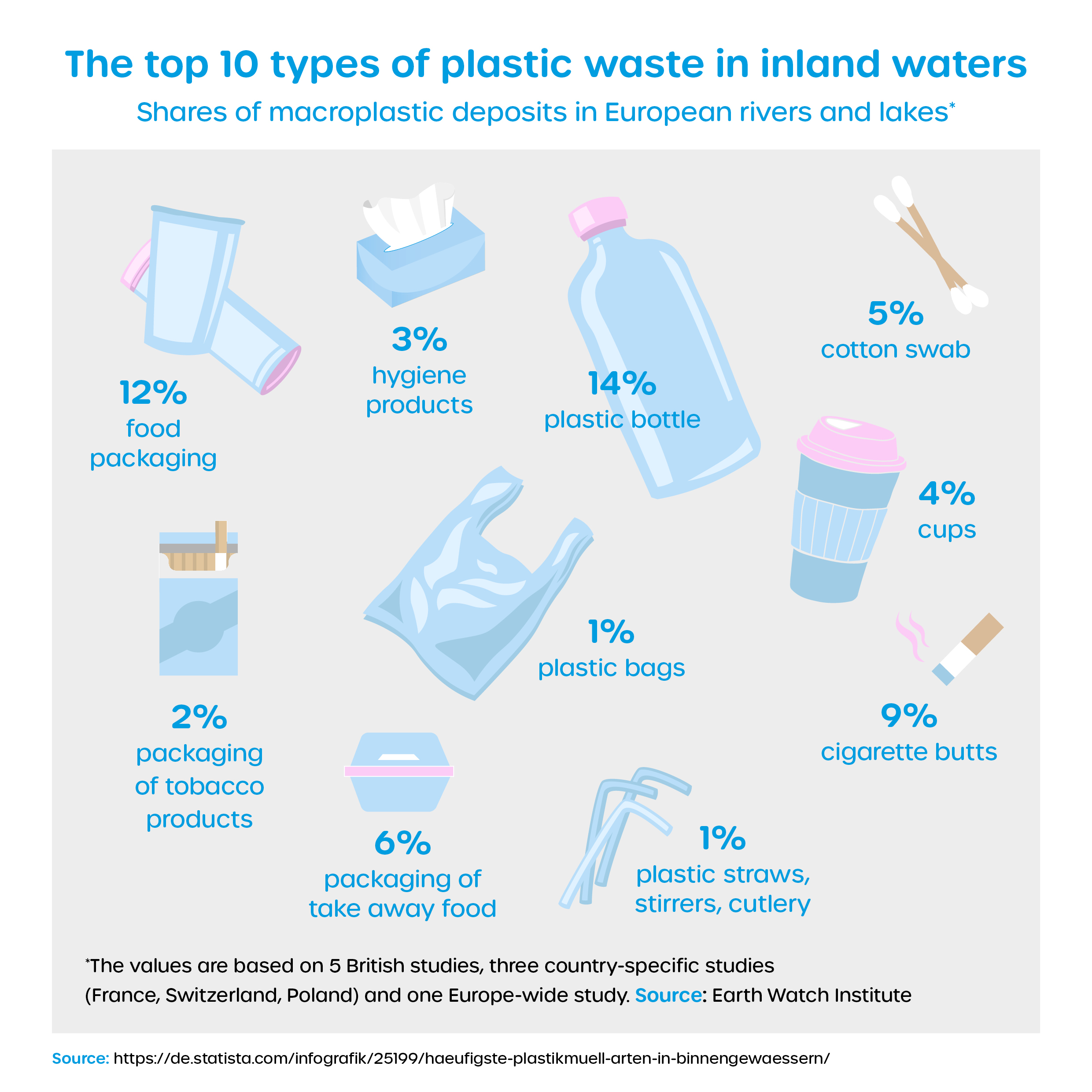
Overview of the most common types of plastic waste in inland waters © Wasser 3.0
What is the difference between Ocean Bound Plastic and Ocean Plastic?
Ocean Bound Plastic:
- Plastic waste that is still on land but at risk of entering the ocean
- Mostly waste within a radius of about 50 km from the coast or waterways
- Often found in areas with inadequate waste management
- Can still be collected and recycled before it reaches the oceans
- Often used in recycling programs to reduce inputs into the marine environment
Ocean Plastic:
- Plastic waste that has already entered marine environments
- Floats in the sea, lies on the seabed, or has been washed up on beaches
- Often damaged by salt water, UV radiation, and mechanical action
- More difficult to collect and recycle due to degradation and contamination
- Also includes microplastics created by decomposition
The main difference is that Ocean Bound Plastic is collected preventively to stop it from becoming Ocean Plastic. Ocean Bound Plastic is therefore usually in better condition and potentially more suitable for recycling processes.
What the available life cycle assessments show – and what they do not: Insights into the Life Cycle Assessment (LCA)
LCA studies by the Association of Plastic Recyclers show clear advantages for recycled plastic: recycled PET requires only 24% of the total energy of virgin PET and causes only 41% of greenhouse gas emissions.
|
FACT-CHECK NOTE This study compares recyclate with virgin material in conventional recycling. It contains no data on Ocean Bound Plastics and therefore does not substantiate any claim about OBP material. The figures are US data (cradle-to-resin, reference year 2020) and may only be applied to European conditions with an explicit note to that effect. |
Concrete figures (per kg plastic, US data, reference year 2020):
- ▪ Virgin PET: 61.4 MJ energy, 2.23 kg CO₂ equivalent
- Recycled PET: 14.8 MJ energy, 0.91 kg CO₂ equivalent
- Virgin HDPE: 75.3 MJ energy, 1.89 kg CO₂ equivalent
- Recycled HDPE: 8.7 MJ energy, 0.56 kg CO₂ equivalent
Furthermore, industry analyses (not peer-reviewed) show that utilizing the waste as raw material is hardly economically viable. Preparing a ton of waste so that it can be further processed as raw material is estimated at around 20,000 euros. No robust, methodologically transparent cost calculation has been published for this figure. With many marine plastic articles, the energy and environmental balance would likely turn out poorly because of the demanding recycling process; no published life cycle assessment for such products is available to us.
Textile engineer Kai Nebel (Reutlingen University) considers the life cycle balance of clothing made from 100% recycled material to be considerably worse than its marketing suggests
Marketing patterns and incorrect communication in context
Pattern 1: Conceptual confusion
Reporting has cited Adidas as an example. According to the company, the material used comes from beaches and coastal regions and was collected there before it could reach the ocean. The accompanying advertising, however, suggested an origin in the sea. From 27 September 2026, such a presentation would qualify as an inaccurate origin claim – including where it is conveyed solely through imagery, since under the EmpCo Directive environmental claims expressly cover images, symbols and brand names as well.
Pattern 2: Shifting attention away from the overall footprint
Coca-Cola presented a bottle prototype in 2019 that contained around 25% recycled marine plastic. This was a small demonstration run, not a change to the product range – a distinction frequently lost in media coverage and one that, from 27 September 2026, would be impermissible as an inaccurate claim about the scope of an environmental benefit. The project should be seen in context: Coca-Cola has repeatedly been identified in the annual brand audits of the Break Free From Plastic initiative as the brand most frequently found in global clean-ups, and has reported an annual plastic packaging volume in the order of 3 million tonnes under the Ellen MacArthur Foundation Global Commitment.
The reality: minimal actual marine plastic content
Clothing made entirely from ghost nets or marine debris is not, to our knowledge, available on the market. In the material mix, such fractions can only be present in small proportions. Unlike what advertising promises, a purchase hardly removes any waste from the oceans, because ghost nets are difficult to recover and recycle.
Why are Ocean Bound Plastics so expensive?
Complex collection process
- Collection in remote coastal regions
- Manual sorting of different plastic type
- Transportation from areas that are difficult to access
Complex processing
- Removal of salt, sand, and biological residues
- Sorting of heavily degraded materials
- Complex cleaning processes
Low material quality
The collected material is often heavily degraded and only suitable for low-grade applications.
A comparison of the costs per ton of processed PET shows the order of magnitude:
- New: 1,100–1,300 euros/ton (2024)
- Conventionally recycled: 1,250–1,300 euros/ton (flakes, 2024)
- Ocean Bound Plastics: 15,000–20,000 euros/ton (2022)
|
FACT-CHECK NOTE These figures come from different reference years (2022 and 2024) and from market and trade-press sources. They are therefore not directly comparable and must not be converted into a multiplier. A robust comparison requires figures from the same reference year. |
An example: the production cost of a simple letter opener made from Ocean Plastics is estimated at 200 euros.
Approaches to real transformation: the EU circular economy as a framework
The EU Strategy for Plastics in a Circular Economy pursues an ambitious approach to the recyclability of plastic packaging and contains a response to microplastics as a significant source of marine pollution. Concrete transformation strategies include:
- Design for Circularity
By 2030, all plastic packaging on the EU market should be either reusable or cost-effectively recyclable. This target originates from the 2018 EU Plastics Strategy and is further specified by the EU Packaging and Packaging Waste Regulation.
- Extended Producer Responsibility (EPR)
EPR systems obligate manufacturers to take responsibility throughout the entire life cycle of their products.
- Prevention before recycling
The fundamental problem is that too much is produced and thrown away. A key driver is overproduction: large volumes are cheaper per unit than smaller runs. Specific percentages for unsold or directly discarded goods vary considerably between studies and should only be cited with a source and reference year.
The Balance
On the current evidence, Ocean Bound Plastics are not the ecological revolution they are marketed as:
- Energy balance: no published comparative life cycle assessments exist for OBP material. A quantified claim about its performance relative to conventional recycling is therefore not currently substantiable.
- Costs: several times more expensive than virgin material according to market and trade-press sources. The underlying figures come from different reference years and do not permit an exact multiplier.
- Availability: actual marine plastic is recyclable only with considerable effort and to a limited extent
- Greenwashing risk: high – particularly in view of the requirements binding from 27 September 2026
Real change requires a circular economy: systemic measures and long-term solutions instead of short-term consumption strategies. Priorities for a genuine plastic transformation:
- Drastic reduction of plastic production, especially single-use products
- Design for Circularity with mandatory standards
- Investment in mechanical recycling for single-polymer streams
- Extended Producer Responsibility with complete cost transfer
- Ocean Bound Plastics only as a niche solution with transparent life cycle assessment
In our assessment, Ocean Bound Plastics do not solve the plastic crisis but distract from systemic solutions. The future lies not in elaborate recycling of marine plastic, but in the drastic reduction of plastic production and building a true circular economy.
Those who want real environmental protection should see Ocean Bound Plastics for what they predominantly are on the current evidence: an expensive marketing instrument that distracts from necessary systemic changes.
|
TRANSPARENCY NOTE ON SOURCES AND DATA STATUS Peer-reviewed: Jambeck et al., Science, 2015. Expert report: Association of Plastic Recyclers / Franklin Associates, LCA 2020 (US data). Market and trade-press sources: price figures for 2022 and 2024. NGO and association sources: Break Free From Plastic, Ellen MacArthur Foundation. Evaluative statements are marked as such in the text. Research status: September 2026. Legal framework: Directive (EU) 2024/825 in conjunction with the national transposition, in Germany the UWG. |