
Microplastic Detectives: Mannheim Researches for Tomorrow
4. June 2026
Van Remmen UV Technology Becomes Mileage Partner of DANUBE 2850
17. June 2026
Swimwear as an Invisible Source of Microplastics: What Swimming Really Leaves Behind in Our Waters
A hot summer day at the lake. A river flowing through a city. A dive in the swimming pool. What we all take for granted as a natural part of our summer has a dark side that we still know too little about: Our swimwear releases microfibers directly into the water while we wear it. Not just during washing. But while swimming itself.
Until a few years ago, this entry pathway was practically unexplored in research. In 2024, a field study in the Salt River in Arizona provided hard numbers for the first time: During peak afternoon activity hours, the microplastic concentration in the river surged to eight times the morning values, from 27,798 to 222,391 particles per cubic meter. In nearby apartment pools, up to 254,574 particles per cubic meter were measured. More than 70 percent of these particles were fibers. At peak times, polyamide fibers alone accounted for 78 percent of all identified particles – exactly the polymer used in typical swimwear with elastane content.
What does this mean? Is swimming its own distinct entry pathway for microplastics into the environment?
Polyamide, Polyester, Neoprene: A Material Science of Swimwear
Classic swimwear and sportswear typically consist of a blend of 80 percent polyamide (nylon) and 20 percent elastane, a combination that provides elasticity, body-hugging fit, and fast drying. Competitive and printed swimwear relies on polyester-elastane blends in a similar composition. Wetsuits consist fundamentally of foamed polychloroprene and are laminated on both sides with polyester or polyamide fabrics.
All three polymer classes are synthetic, petrochemical, and persistent. A recent review paper in Environmental Chemistry Letters classifies them as an under-researched material class: functional textiles have so far been studied in research mainly using the example of polyester and polyamide from classic everyday clothing. For spandex, neoprene, and Gore-Tex, quantitative shedding data is largely missing despite a massively growing prevalence in the consumer sector.
Three findings from peer-reviewed literature are particularly relevant for swimwear:
- First: A Spanish study by the Universitat Politècnica de Catalunya from 2019 quantitatively measured polyester-elastane fabrics in the 80/20 blend typical for sportswear for the first time: 175 microfibers per gram of fabric per wash under explicitly low-emission conditions. Real-world conditions yield higher values. The study also shows a strong correlation between the fabric's basis weight and fiber emission (R2 = 0.89). Translated: The denser and heavier a fabric, the more fibers it releases per square meter. Following this logic, wetsuits with their high basis weights represent a high-risk class.
- Second: Polychloroprene, the polymer of neoprene, is described in a recent editorial by Gao and Lichtfouse et al. not only as highly persistent (barely biodegradable, difficult to hydrolyze) but also explicitly as a strong candidate for an absorptive sink for hydrophobic organic pollutants in waters. Released neoprene microparticles can therefore not only act as primary microplastics but additionally as a carrier medium for other toxins. A double ecotoxicological burden.
- Third: Recycled synthetics are not a corrective measure when it comes to washing and wearing behavior. An Australian study on activewear and swimwear fabrics compared four fabric variants in 2018, including recycled nylon/elastane and conventional nylon/elastane. The result: no significant difference in fiber release. Even after fifteen washes, the emission level remained constant; a complete washing-out of loose fibers does not occur.
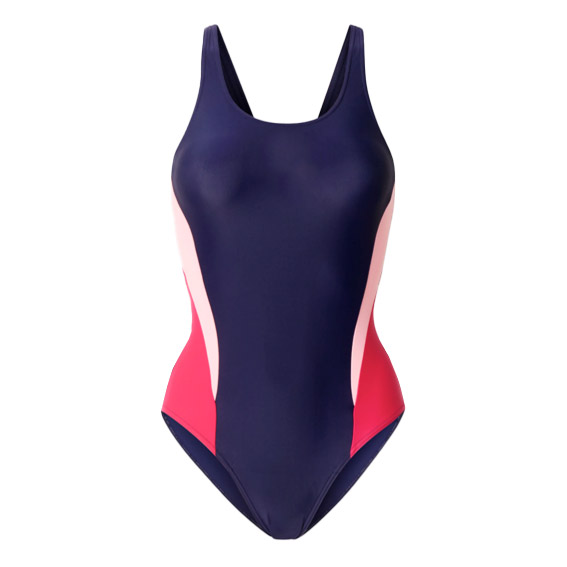
Before: Swimsuit (example photo)
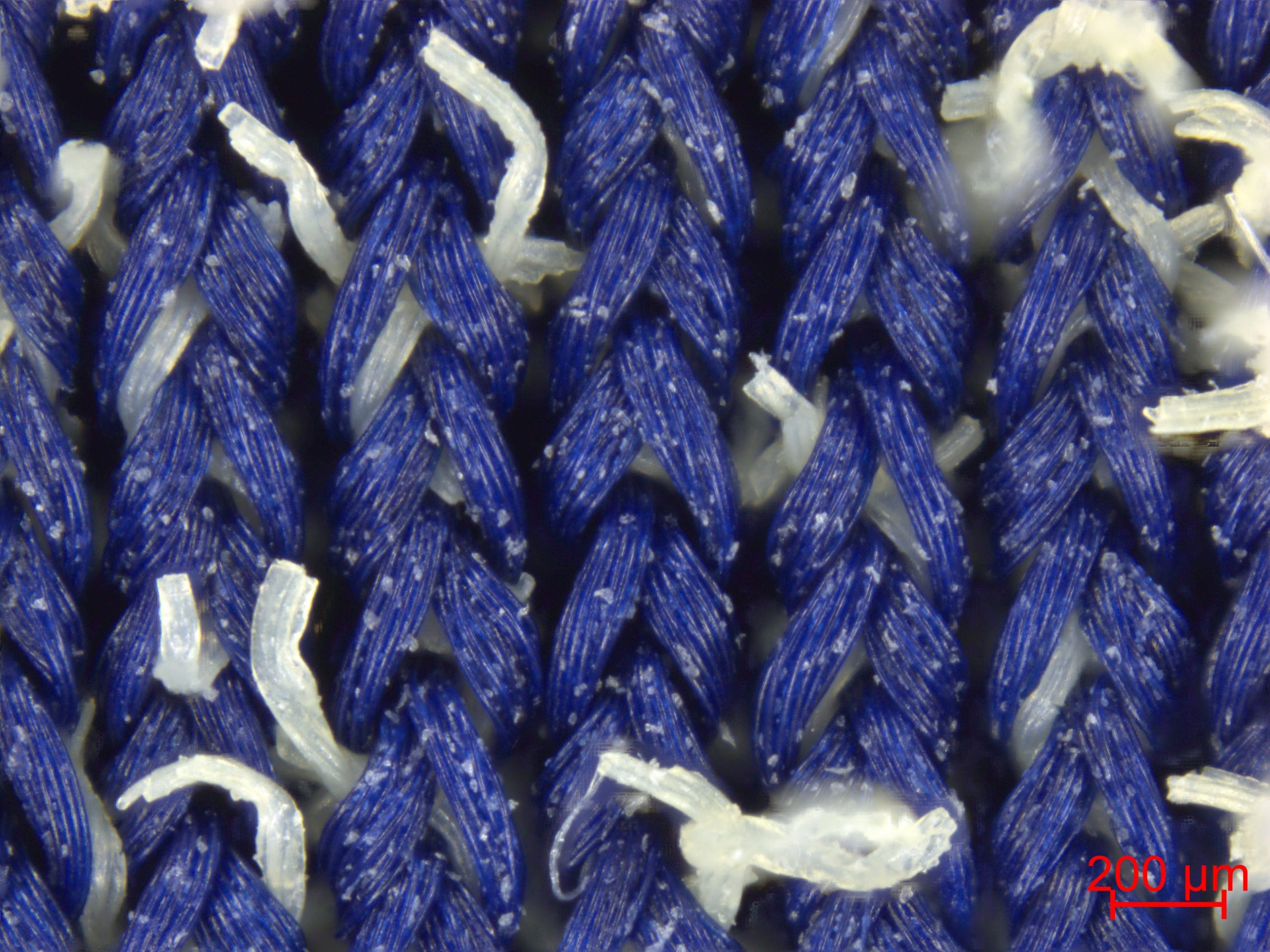
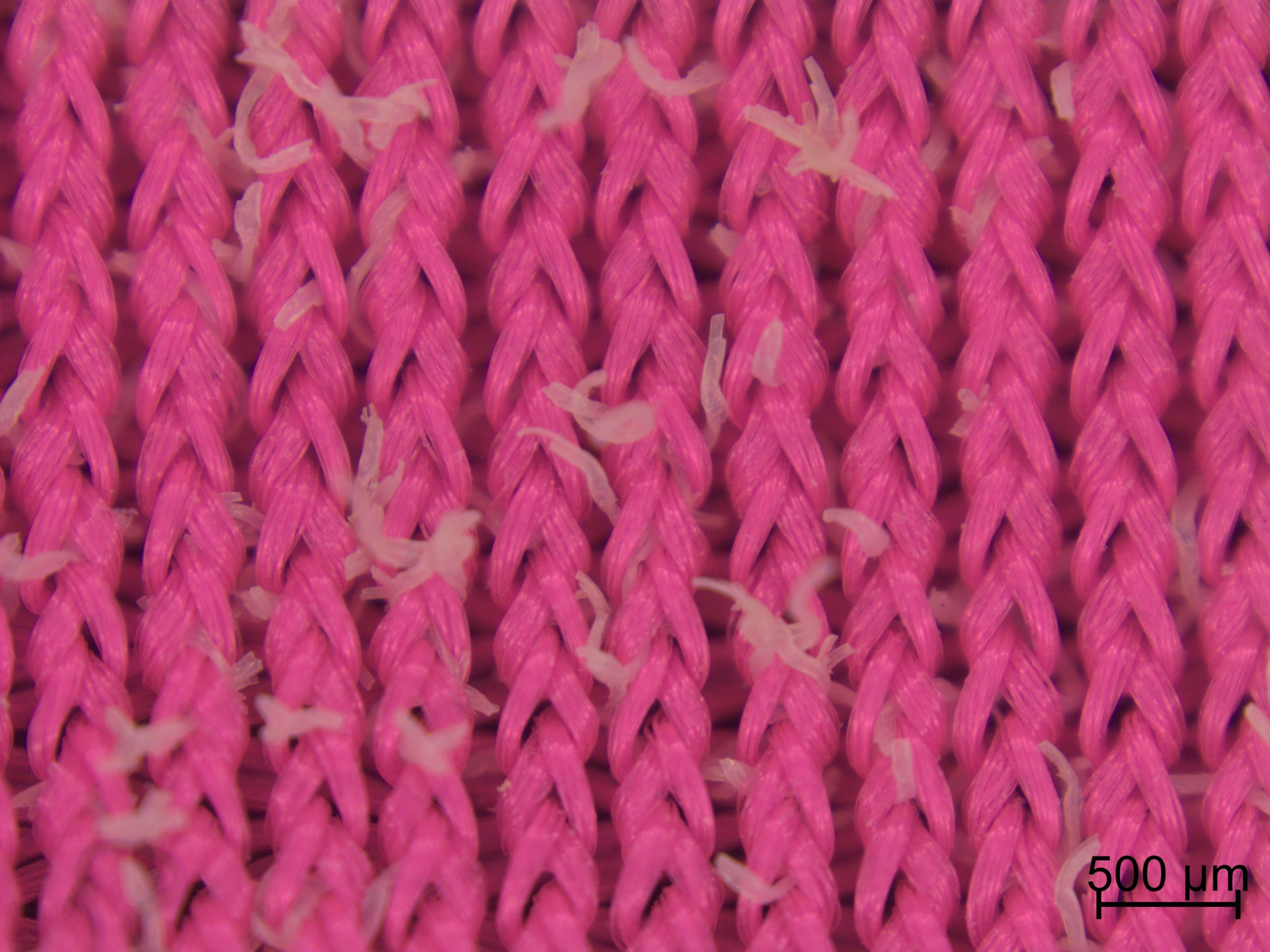
After: Swimsuit (light microscope image) Left: blue fibers; right: pink fibers © Wasser 3.0
Three Overlapping Entry Pathways
The research findings condense into a clear picture: microfibers from swimwear and swimming apparel reach our waters via three overlapping pathways.
- Pathway 1: Washing. The classic, most thoroughly researched pathway. After swimming, the swimwear is washed, the fibers enter the wastewater, the municipal sewage treatment plant retains a portion, and the rest passes through the primary mechanical treatment because the fiber dimensions, with diameters of 12 to 18 micrometers and lengths of 360 to 660 micrometers in the dominant fraction, are smaller than the mesh sizes of common screens. You can read about how to discharge 70% less microplastics into wastewater using the correct appliance settings and wash parameters while saving money in our blog post "Microplastics and Textiles".
- Pathway 2: Air. A study by De Falco et al. from 2020 proved for the first time that the simple act of wearing synthetic clothing releases fibers into the air, on a scale of around 1 billion fibers per person per year, roughly three times more than during washing. These fibers reach bodies of water via atmospheric deposition and precipitation.
- Pathway 3: Water. The previously underestimated pathway. If wearing clothes in the air causes measurable fiber emissions, an analogous direct input when wearing them in water is plausible amplified by the mechanical stress continuously at work in water (friction, stretching, currents). The field findings from Arizona confirm the scale: High user density plus synthetic clothing equals a measurable increase in fiber concentration. Directly in the receiving body of water.
Why Smaller Particles Are the Bigger Problem
Research in recent years has brought a fundamentally critical shift in accounting terms. Until 2019, the IUCN report by Boucher and Friot from 2017 was considered the central global reference: according to it, an estimated 520,000 tons of microfibers per year entered the oceans from textiles, at around 3.6 x 10¹⁵ particles per year. The Spanish study by Belzagui and colleagues empirically recalculated this estimate in 2019: a factor of 30 lower mass, but a factor of 40 higher particle count.
The reason is sobering: Boucher and Friot had assumed an average fiber length of 5 millimeters and a linear weight of 300 dtex. Measured on average are 0.3 millimeters in length and 4.34 dtex – much smaller, much more numerous particles.
Why is this worse news?
Because smaller particles are biologically easier to ingest. They pass through mechanical filters, they are taken up by filter feeders like mussels and daphnia, and they enter the food web through plankton. A mass-based risk assessment systematically underestimates the ecotoxicological impact.
In freshwater – in lakes, rivers, and streams – this effect is further amplified: the water column is smaller, dilution is lower, and the retention time is longer than in the sea.
What You Can Do Yourself When Washing (and What Doesn't Help)
Research by Wasser 3.0 shows that with simple adjustments, 70 percent or more of fiber release during washing can be avoided—entirely without additional devices or a new machine:
- Lower the wash temperature (60°C→ 30°C)
- Reduce the spin speed (1200 → 600 U/min)
- Use detergent selectively
- Wash synthetics less frequently and only when truly necessary
Wasser 3.0 explicitly points out: Microfiber filters in washing machines are not a comprehensive solution.They shift the problem to residual waste and address only one of the three entry pathways. The effective levers lie earlier—in the material, the design, and the industry.
What This Has to Do with the Danube
The Danube is Europe's second-longest river. 2,850 kilometers through ten countries. 83 million people live in its catchment area. Around 20 million people drink its water daily.
Estimates claim that around 4.2 tons of microplastics flow through the Danube every single day, equivalent to the weight of 42,000 plastic bottles.
What has been missing until now: uniform, comparable data on microplastic pollution across all ten riparian states. Without this data, EU policymakers cannot set effective limit values, cannot bindingly operationalize a watch list, and cannot prioritize measures based on evidence. This is exactly why microplastics were initially placed on the watch list in the newly adopted Directive (EU) 2026/805, the recast of the EU Water Framework Directive in force since May 10, 2026, rather than being subject to binding environmental quality standards. If harmonized measurement methods are lacking, the legal basis for limit values is missing.
This is where the Danube Challenge 2026 comes in: In July 2026, extreme swimmer Dr. Joseph Heß will swim the entire 2,850 kilometers of the Danube from source to mouth. 60 days. 8 to 10 hours of swimming daily. In cooperation with Wasser 3.0, this will produce the first complete microplastic mapping of a European river. Over 250 water samples will flow directly into the Global Map of Microplastics and thus into the scientific foundation on which EU politics can decide in the future.
An extreme swimmer swimming for clean waters and in the process coming into direct contact himself with the very material we are discussing here: neoprene. The symbolic value is obvious. The scientific necessity is too.
Support us with your donation for clean water without microplastics.
What It Takes to Truly Reduce the Burden
Four concrete levers can be derived from the analyzed studies, none of which rest solely with consumers:
- Material Choice on the Product Side: The construction of a fabric, yarn twist, continuous filament yarns, dense weaves are, according to all available studies, the primary lever for reduced fiber release. Manufacturers of swimwear and diving gear have responsibility and leeway here. Densely woven constructions release significantly fewer fibers than knitted or pilling-prone fabrics.
- Industrial Pre-treatment: The first washes of a new piece of clothing release drastically more fibers than later ones. Industrial pre-washing with filter systems could catch a significant portion of this initial input before the product even reaches the consumer.
- Conscious Use: Swimwear does not need to be machine-washed after every wear. Rinsing with clear water is often enough. If machine washing is necessary, do so at a low temperature and reduced spin speed.
- Measure, Measure, Measure: The EU WFD watch list will only evolve into a list of priority substances with binding limit values if harmonized measurement data is available in sufficient quantities. This is exactly what projects like the Danube Challenge deliver.
What does not help: shifting the problem solely onto consumers. Or believing that a filter on the washing machine solves it. Microfibers from swimwear enter the water directly in the water while being worn. A machine filter is of no help there.
Tracking Down the Perpetrators
Anyone wanting to understand the topic in its full depth will find the scientific investigative work in the new book "Kriminalfall Mikroplastik – Ermittlungen in ein Jahrhundertverbrechen" (The Microplastics Case – Investigating a Crime of the Century, available only in German) by Dr. Katrin Schuhen. Not an indictment. Not scaremongering. An investigation with evidence, culprits, and options for action.
150 pages, softcover, produced Cradle to Cradle. 100 percent of the proceeds flow into research and education for water without microplastics.
Let's Not Swim in the Dark
Microplastics from swimwear and swimming apparel is not a marginal topic. It is a systemic problem sitting at the intersection of the textile industry, consumer behavior, and water management. The EU Water Framework Directive 2026/805 took the first step but without binding limit values. The Danube Challenge 2026 is now delivering the data work that makes binding limit values possible in the first place.
We eat, drink, and breathe microplastics. We also wear it and release it directly into the water while swimming. But we can decide how we deal with it.