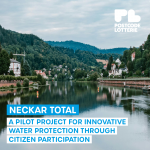
Microplastic Mapping of the Neckar
22. April 2026
VisualVest as German Partner of the Danube Challenge
22. May 2026
The Case of Invisible Traces:
Why the Right Sample Makes All the Difference
New Wasser 3.0 study shows: microplastics monitoring requires precision and a narrative that brings people along
It begins like a good crime story: the culprit is tiny, nearly invisible, yet leaves traces everywhere - in wastewater treatment plant (WWTP) effluents, stormwater overflows, river water, and even in drinking water from the tap.
The question driving investigators in laboratories worldwide is no longer whether microplastics (MP) exist in our waters, but how much, and above all, how can we measure them reliably?
This is precisely where our new publication in the journal Microplastics comes in. It delivers the most concrete answer yet to an underestimated question: Which sampling strategy produces robust data for MP detection and how many samples are actually needed?
The Trace Problem: Why Microplastics Monitoring Has Been Struggling
Microplastics do not distribute in water like sugar in tea. They clump, drift, sink, float; heterogeneous, unpredictable, difficult to capture. If you collect only half a liter and count particles, you may simply measure an outlier. If you filter one hundred liters, another challenge emerges: the sample becomes overloaded, filters clog, and subsampling becomes necessary.
Until now, harmonized protocols have been lacking. Studies used different volumes, sampling devices, and analytical methods, making results barely comparable. Our microplastics research addressed exactly this leverage point.
The Investigation: Four Crime Scenes, Two Methods, One Clear Result
The team led by Dr. Katrin Schuhen compared two sampling strategies across four real water matrices: effluent from the Landau-Mörlheim WWTP, drinking water from the local tap-water connection, a combined sewer overflow (during heavy rain events), and surface water from the Queich River, about 400 meters downstream of the WWTP discharge
- Method A – Classic Grab Sampling: 5 liters collected in amber glass bottles with five replicates
- Method B – Particle Sampling Unit (PSU): 100 liters pumped directly through a 10-µm filter cartridge; the sample is then subdivided and analyzed in the lab
To test the recovery, defined quantities of fluorescence-labeled polyamide (PA) particles (357 ± 60 µm) were added. The “tagged suspects” are expected to reappear later in fluorescence microscopy.
The Results: PSU Outperforms Grab Sampling in Precision
The results read like a forensic report, and they are clear: the PSU sampling achieved substantially higher precision, with a mean relative standard deviation of 41 ± 17%, while grab samples showed 64 ± 19%. At three out of four sampling sites – wastewater effluent, surface water, and drinking water – the 100-liter method was clearly superior.
The recovery showed a different picture: grab samples reached 93 ± 7% recovery, while PSU samples with full filter analysis achieved 88 ± 23%. The reason: In smaller grab samples, the spiked particles represented a larger fraction of the total particle count, making detection more pronounced.
The Key Practical Finding
- To achieve ±25% error tolerance at 95% confidence, you need 21 PSU samples or 51 grab samples.
- For ±10% error tolerance you need 131 PSU samples or 312 grab samples.
- The relationship between variability and sample number is quadratic: halve the variance, and the required number of samples falls by a factor of four.
Every methodological improvement therefore pays off disproportionately.
From the Lab to the Field: What This Means for Real Monitoring Campaigns
For wastewater operators, environmental agencies, and industry, this means: If robust individual measurements are needed, use the PSU. If many sampling points and simple logistics matter, then conduct grab sampling but increase the sampling replications accordingly.
Both routes can deliver valid results if their rules are understood. The fluorescence-based analysis method we applied produces rapid results, which is crucial when cities, industries, or environmental projects aim for broad monitoring coverage.
A second key aspect is contamination control. Reliable results also depend on excluding false positives. Only laboratories using dedicated clean lab spaces, air filtration, lint-free clothing, and only glass equipment can effectively control contamination. This study provides a practical protocol for exactly that.
From Scientific Journal to Crime Story: Criminal Case Microplastics
It is precisely at this intersection – between rigorous research and social reality – that Dr. Katrin Schuhen’s new book begins. “Criminal Case Microplastics: Investigating a Crime of the Century”.
Dr. Schuhen guides readers through a case that affects us all: microplastics in the blood, in breast milk, in drinking water. Who knew what? Who remained silent? Who profits? And most importantly – what can each and every one of us do starting today?
The book is not a scare-tactic, but an investigation. It combines evidence-based data (including studies like the one described above) with social criticism and concrete everyday suggestions: specifically reducing plastic packaging, washing synthetic clothing less often, switching to bulk instead of packaged food where possible. Not one perfect solution, but effective steps that add up.

Why the Two Go Hand in Hand
The scientific journal article and the book tell the same story on two levels. Science provides the methodology for reliably measuring microplastic contamination – the prerequisite for ensuring that monitoring programs, threshold values, and evidence hold up in court and in the public eye. The book translates these findings into language that is understandable without a degree in chemistry and empowers people to take action.
Together, these represent the mission of Wasser 3.0: to detect, remove, and reuse microplastics without leaving society behind.
The culprit may be invisible. The tools to convict them no longer are.