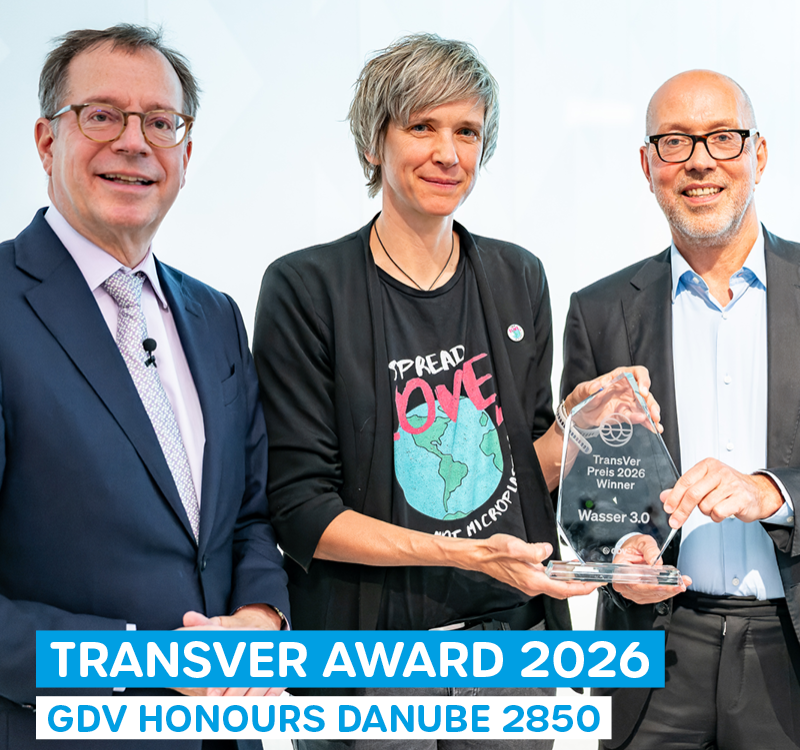
TransVer Award 2026: GDV Honours DANUBE 2850
20. November 2026
Neisse and Neckar: What More Than 300 Water Samples Reveal About
Microplastics in Our Rivers
We know that microplastics are in our rivers. Until now, though, we hardly knew exactly where, how much and why there. Our new publication in the journal Environments changes that for two Central European rivers: the Lusatian Neisse and the Neckar.
The study is peer-reviewed, open access and based on more than 300 water samples. Many of them were not taken by lab staff but by pupils, students, a municipal utility and committed citizens. Here we sum up what the results mean and why they matter far beyond these two rivers.
The publication: Sturm, M. T.; Korzin, A.; Zernikel, O.; Schuhen, K. Catchment-Specific Drivers of Microplastic Contamination in Two Central European Rivers: A Citizen Science Monitoring Campaign Along the Neckar and the Lusatian Neisse. Environments 2026, 13, 615. doi.org/10.3390/environments13110615
A first on three levels
What makes this study special is not a single number but the way the data came about. For the first time, these rivers were sampled on three levels at once, everywhere with the same protocol:
- Regional: At the confluence of the Neckar and Rhine in Mannheim, we sampled 12 sites in the port area four times between January and April 2026. School classes added further samples at 15 locations across the city in spring. This shows how strongly microplastics vary within a small area and over time.
- National: We sampled the Neckar along its full 362 kilometres from source to mouth, with 136 samples in just three days in June 2026. On average, there was a sampling point every two kilometres.
- Across borders: The Lusatian Neisse flows 246 kilometres through the Czech Republic, Germany and Poland. We sampled it from the Jizera Mountains to its confluence with the Oder and evaluated 102 river samples.
Because both rivers were sampled with the identical method and analysed in the same lab, they can be compared directly. In microplastics research, that is still the exception: different nets, volumes and detection limits make many published values hard to compare. We explain more in our post Microplastic Analysis vs. Analytics.
The results, explained in plain terms
The Neisse carried clearly more microplastics than the Neckar. In a typical litre of Neisse water we found 22.5 microplastic particles, in the Neckar 5. That is about four and a half times as many. If you draw one random sample from each river, the Neisse sample contains more microplastics in roughly seven out of ten cases. One important caveat: the two rivers were sampled in different months and at different water levels. So the difference describes these two campaigns and is not yet a final verdict on the rivers themselves.
Microplastics come in bursts. Many samples contained no detectable microplastics, while a few contained a lot: up to 503 particles per litre in the Neckar and 569 in the Neisse. Microplastics are not spread evenly like salt in water, but more like clouds in the sky. That is why a single sample can easily be misleading.
The Neisse gets cleaner downstream. Values were highest in the upper reaches around Liberec and Jablonec, a region with centuries of textile history. Over every 100 river kilometres, the load fell to about a third. Whether this is due to the wastewater treatment plants in the upper catchment, to flow conditions or to something else cannot yet be separated with the current data.
Mannheim shows a clear hotspot. Upstream of the Bonadieshafen lock, the mean was 544 particles per litre. At the same spot, values ranged from 5 to 1,591 particles per litre within five weeks. Elevated values were also found near the recycling centre on the Friesenheimer Insel (167 MP/L) and at the Sandhofen ferry (126 MP/L). Anyone measuring only once here could get the situation completely wrong. The pupils of the Microplastic Detectives helped carry exactly this series of measurements.
The demographic and geospatial analysis is in place and points the way to hotspots
For every single sample, we analysed its surroundings: How much settlement and industrial land lies nearby? How far upstream is the nearest wastewater treatment plant, how large is it, how many people does it serve and how many treatment stages does it have? This creates, for the first time, an analytical framework that links microplastic measurements along entire rivers with population, land use and wastewater infrastructure.
The result is revealing precisely because it does not give the expected simple answer: the immediate surroundings of a sampling point, such as a town on the bank or a nearby treatment plant, do not explain the values on their own. Hotspots form where water slows down and particles collect: upstream of locks, in port basins, in impounded reaches. Rainfall, water level and season add to this. A weaker influence of settlements or treatment plants is not ruled out by this. Detecting it reliably, however, needs more and more targeted measurements.
That is exactly what makes the analysis so valuable: it shows where we need to look next. Instead of collecting isolated samples, we now know which stretches should be sampled repeatedly, where paired measurements upstream and downstream of treatment plants make sense, and why river discharge must always be recorded in the future.
Why citizen science makes the difference
On the Neckar alone, more than 300 people took part directly. Of the samples in the longitudinal profile, 21 percent came from school and university groups, 36 percent from volunteers and 39 percent from our team. The key question was: are the volunteers’ data just as good?
The study’s answer: we found no systematic difference. Samples from pupils, volunteers and professional staff gave comparable values. Even samples taken on the same day by different groups just a few hundred metres apart did not differ systematically. This only works under three conditions that we consider essential:
- Standardised: Everyone uses the same lab-supplied amber glass bottles, the same illustrated instructions and the same app, which records location, time, water temperature and a site description. Every sample is checked for plausibility and analysed centrally in one lab with our microplastic analytics.
- Appreciative: Those who take samples are part of the research, not just helpers. Results are discussed with participants, shown publicly in the Global Map of Microplastics and explicitly acknowledged in the publication.
- Society-wide: Schools, universities, municipal utilities, citizens, companies and foundations work together. Only this creates the sampling density that no single research project could achieve.
This is more than a nice educational project. The recast EU Urban Wastewater Treatment Directive foresees regular microplastic monitoring at larger treatment plants. Our study shows that anyone who wants to measure microplastics in rivers reliably needs many measurements at many places and many points in time. Citizen science delivers exactly this density at low cost, provided sampling is standardised and analysis is centralised.
What we recommend based on the study
- Sample fixed sites repeatedly to tell chance peaks from real hotspots.
- Use larger sample volumes or replicate samples where concentrations are low.
- Always record river discharge at the time of sampling.
- Measure specifically upstream and downstream of individual treatment plants.
- Sample across seasons, water levels and after rainfall events.
We are already putting many of these points into practice, for example in mapping the Danube with Danube 2850. For an overview of all ongoing river campaigns, see our post Microplastic Mapping in Germany and Europe.
Thank you to everyone who made this possible
A study of this scale does not fit into any classic funding scheme. It was only possible because foundations, partners and a great many people believed in it. Our heartfelt thanks go to:
- the Veolia Foundation (Germany) and the Fondation Veolia (France) for funding the data2impact project on the Neisse, see NEISSE TOTAL,
- the Deutsche Postcode Lotterie for funding NECKAR TOTAL,
- the ON Foundation for funding the Microplastic Detectives project,
- the around 300 citizen scientists, pupils, students and teachers along the Neckar,
- Oliver Bläß and the students of the Integrierte Gesamtschule Mannheim-Herzogenried for the repeated measurements in the Mannheim port,
- Stadtwerke Görlitz for sampling the Neisse in March 2026,
- abcr GmbH Karlsruhe for its project-related support,
- Vishnu Thete and Hannah Schopp for their work in the lab.
Get involved and support us
Every new sample makes the map more accurate. Here is how you can become part of the solution:
- Schools and universities: Bring real research into the classroom. You will find everything in our offers for educational institutions and in the overview of our education projects.
- Citizens and initiatives: Sample your local waters and contribute data points to the Global Map of Microplastics.
- Supporters: Wasser 3.0 is a non-profit. With a donation for clean water, you fund further river mapping, analytics kits for schools and open data for everyone.
Read the full study free of charge at doi.org/10.3390/environments13110615. The Neisse and Neckar are only the beginning. We would love to have you on board for the next river!
To ensure we can carry on in 2027, we need your support