
Spread Love Not Microplastics: the projects that only exist because of you
Part of our work reaches the pace we understand as impact acceleration only with the help of donations and sponsorship.
School classes taking their own scientific measurements. Water days at rivers. An entire lake on a single day. For these projects there is no single funding pot — only people and companies who make them possible. This page brings them together.
We are a non-profit company based in Karlsruhe. What we do with your money is set out here in units you can check: one water sample, one class set of books, one research day.
What that looks like when it works, we showed on the Danube in 2026: 2,850 kilometres, ten countries, all data open. The review is further down.
As at August 2026 | Next update December 2026
Current projects for which we are raising funds and seeking sponsors
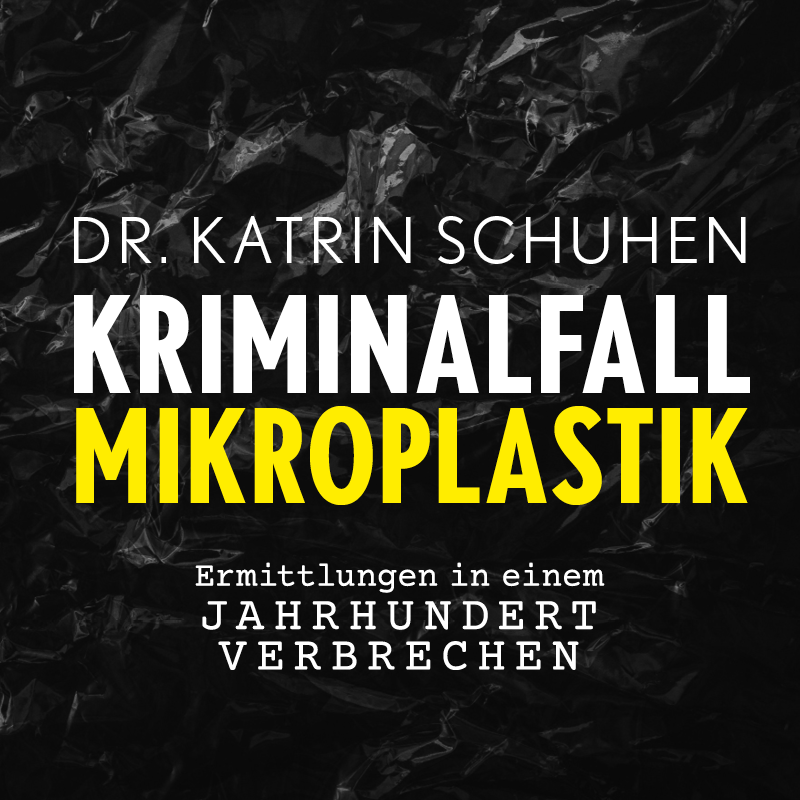
The Microplastic Case ("Kriminalfall Mikroplastik") : when a school class collects its own data for the first time
A sponsorship brings science into the classroom — not as a lecture but as the pupils' own investigation. The class receives a class set of the book "Kriminalfall Mikroplastik" by Dr Katrin Schuhen together with its workbook, and we fund two water samples that the class takes and we analyse in the laboratory.
The sequence follows what scientific practice actually is: ask a question, choose a water body, sample to a standard, obtain measured values, interpret them and publish. At the end there is a data point of the class's own in the Global Map of Microplastics — set against international comparison, not filed in a drawer.
For teachers this connects to education for sustainable development and to cross-curricular project work: chemistry and biology supply the method, geography the setting, civics and ethics the question of what to do with the result. The book stays with the class afterwards, and so does the workbook. Knowledge that does not end with the project day.
For you as a sponsor: you choose the school — in your region, at your site, or where your employees went to school. You receive images, quotes and your class's measurement data for your own use.
Unit: one class set of books with workbook plus two water samples. More on the book on the Kriminalfall Mikroplastik page (German), details of the sponsorship in the short concept (German). Our understanding of education is set out in our educational mission, the current school offering under Schools & Citizen Science.
Strong through Water: environmental education that strengthens rather than frightens
Explaining the situation to young people without giving them a way to act makes things worse. Stark durch Wasser starts exactly there: pupils investigate microplastics in the waters of their own region and work in guided resilience workshops on translating worry into action.
The need is documented. In a survey of 10,000 young people aged 16 to 25 across ten countries, 75 % said the future frightened them (Hickman et al., Lancet Planetary Health 202100278-3)). Environmental education that only supplies figures reinforces that feeling. Environmental education that produces measured values of one's own changes it: "What can I possibly do?" becomes "I measured something nobody knew before."
Achieved so far: 120 pupils became citizen scientists, four teachers became multipliers, and more than 80 water samples were analysed.
Unit: one research day for a class, or a full school year at one school, each with an integrated resilience workshop. The full concept is in the project paper (German).

We take action, we deliver: The Danube Challenge shows what is possible.
In 2026, we sampled the entire length of the Danube for microplastics for the first time—2,850 kilometers across ten countries, swum by Dr. Joseph Heß, analyzed by us, and supported by over 200 donors and sponsors. The project concludes on September 1, 2026. All data will soon be publicly accessible.
We highlight this project here because it answers the question that arises before every funding decision: Does it yield tangible results? With "Donau 2850," two approaches ran in parallel, and both were successful.
Many individuals. People contributed small amounts via a donation platform and followed the journey. This generated a level of reach that no advertising budget could have purchased.
A few major partners. At the same time, we approached companies directly—as kilometer partners or regional partners. Our pitch was concrete: a specific stretch of the river, a visible contribution, and a named result.
What remains is not just campaign imagery, but data. This data is hosted on the Global Map of Microplastics, is citable, and remains permanently accessible. To read more about what was measured and who made it possible, visit the "Donau 2850" campaign page.
How funding works
- You get in touch. One sentence is enough. We arrange a conversation.
- We agree the scope. Which project, what size, which region. We calculate in units, not in packages — any contribution can be adjusted up or down.
- You choose the form. A donation with a tax receipt, or sponsorship with an invoice. Both are possible, and the tax consequences differ.
- You get what you need. Measurement data, images and video, quotes, and a mention as a funder if you want one. For sustainability reporting we supply site-specific measurement data that connects to ESRS E2 (pollution) and E3 (water).
What we do not claim: that funding discharges your reporting obligations. Whether and how the data enters your reporting is decided by your audit, not by us.
What happens to your money
We are recognised as a non-profit and issue a tax receipt on request. Details on structure, sources and use of funds are under Transparency.
Everything the projects produce scientifically is published in full open access: Publications. How our analytics work and where their limits lie is under Microplastic Analytics and Sustainability.
Your donation goes entirely towards project work. We cover administrative and transaction costs using our own funds and revenue from contracts.
Why we ask for money rather than attention
Microplastics have been detected in water bodies, in food and in the human body. What is missing is comprehensive, comparable data — and without it, neither regulation nor verification of whether a measure works is possible.
We have examined how many samples that takes: for a ± 25 % margin of error at 95 % confidence, 21 large-volume samples or 51 grab samples are required (Microplastics 2026, 5, 75). Every funded sample is therefore not a symbol but a data point that makes a statement more robust.
Talk to us
One sentence is enough: "We want to be part of this." We will get back to you personally and work out what fits. Contact or donate directly.
You can find onging news in our blog.