Microplastic Analytics: Precise, Fast, and Cost-Effective
The innovative solution for continuous microplastic monitoring in municipal & industrial wastewater and water bodies
The Challenge: Flying Blind with Microplastics
Conventional microplastic detection methods are complex, time-consuming, and expensive. They are primarily used in research and are not suitable for continuous monitoring or large-scale applications. The consequence: A lack of data on actual microplastic pollution in our waters and treatment processes.
The Solution: Wasser 3.0 detect
Wasser 3.0 detect ends the "flying blind" mode with a standardized, fast, and cost-efficient method. Our patented fluorescence markers enable continuous monitoring of microplastic pollution for the first time.
Your Advantages at a Glance
- Fast: Results in record time instead of waiting weeks
- Cost-Effective: Up to 90% cheaper than conventional analysis methods
- Comparable: Standardized procedure for reliable, reproducible data
- Scientifically Validated: Over 700 samples in wastewater treatment plant effluent and 500+ sample points in water body monitoring
- Flexible Deployment: For municipal & industrial wastewater as well as water body monitoring
Innovative Technology: How it Works
1. Patented Fluorescence Markers
Our specially developed fluorescence markers are added to the water sample and selectively stain microplastic particles. The result: Strong fluorescence in synthetic particles, negligible or no signal in natural particles.
2. Automated Evaluation
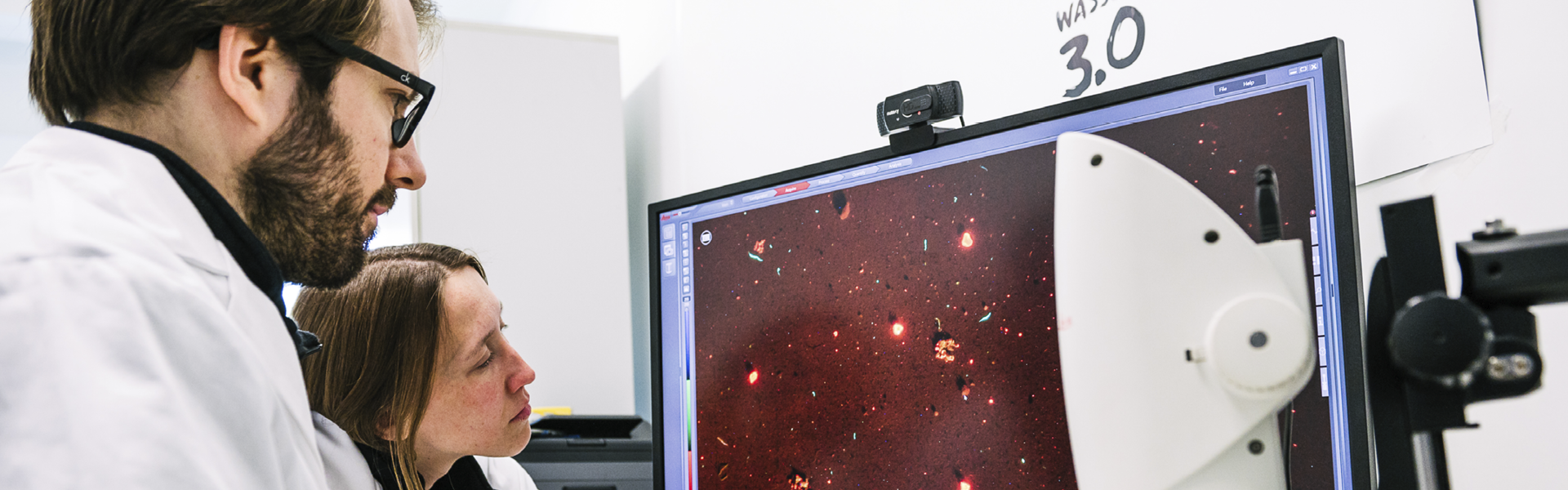
Fluorescence images are automatically evaluated to precisely determine the number of microplastic particles. The software counts luminous particles and provides reliable measurement results.
3. Standardized Sampling with PSU
The Particle Sampling Unit (PSU) enables comparable sampling of large volumes (0.1 m³ – 10 m³) from wastewater treatment plants and water bodies. Small, mobile, and practicle for maximum flexibility.
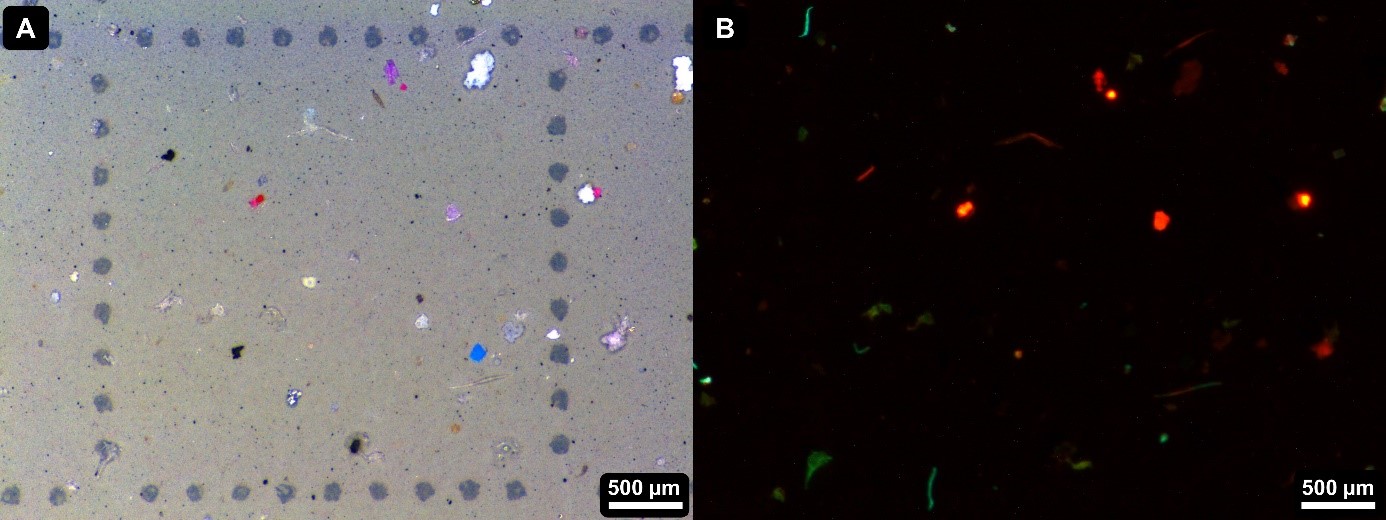
Without fluorescence labelling, there is no differentiation between natural and synthetic particles. Fluorescent labelling makes the synthetic particles visible. Luminous particles are counted using software. | © Wasser 3.0
Areas of Application
- Municipal Wastewater Treatment Plants: Monitoring microplastic removal and process optimization
- Industrial Wastewater: Quality control and compliance verification
- Water Body Monitoring: Recording microplastic pollution in rivers, lakes, and oceans
- Educational Institutions: Practical environmental education and scientific projects
- Research & Development: Validation of new treatment technologies
All-Round Carefree Service
Wasser 3.0 offers a complete service from sampling and detection to reporting. After scheduling an appointment, we take care of the entire process – you receive scientifically validated results without having to worry about execution.
Get Involved Now
For Wastewater Treatment Plants and Industrial Operations
Determine the microplastic pollution in your processes and optimize your treatment technology. Contact us for an individual quote.
For Schools and Educational Institutions
Make environmental science tangible! We offer special programs for schools and educational institutions. Discover our offers for schools.
Order Analytics Kit
Would you like to conduct analyses yourself? Order your analytics kit here and start microplastic detection.
Scientifically Validated and Proven in Practice
Our technology has been tested in numerous research and scaling projects on various water types:
✓ Over 700 samples in the effluent of municipal wastewater treatment plants
✓ More than 500 sample points in water body monitoring worldwide
Why Wasser 3.0 detect?
As a leading solution for microplastic analytics, Wasser 3.0 detect combines scientific excellence with practical applicability. Whether for evaluating wastewater treatment processes, water body monitoring, or environmental education – our technology provides reliable data for informed decisions in environmental protection.
Ready for the next step?
Contact us today and find out how Wasser 3.0 detect can revolutionize your microplastic analysis. Write us an email.
Further information